

Deadline Extended | Global China-Africa Writing Competition
ATTENTION!
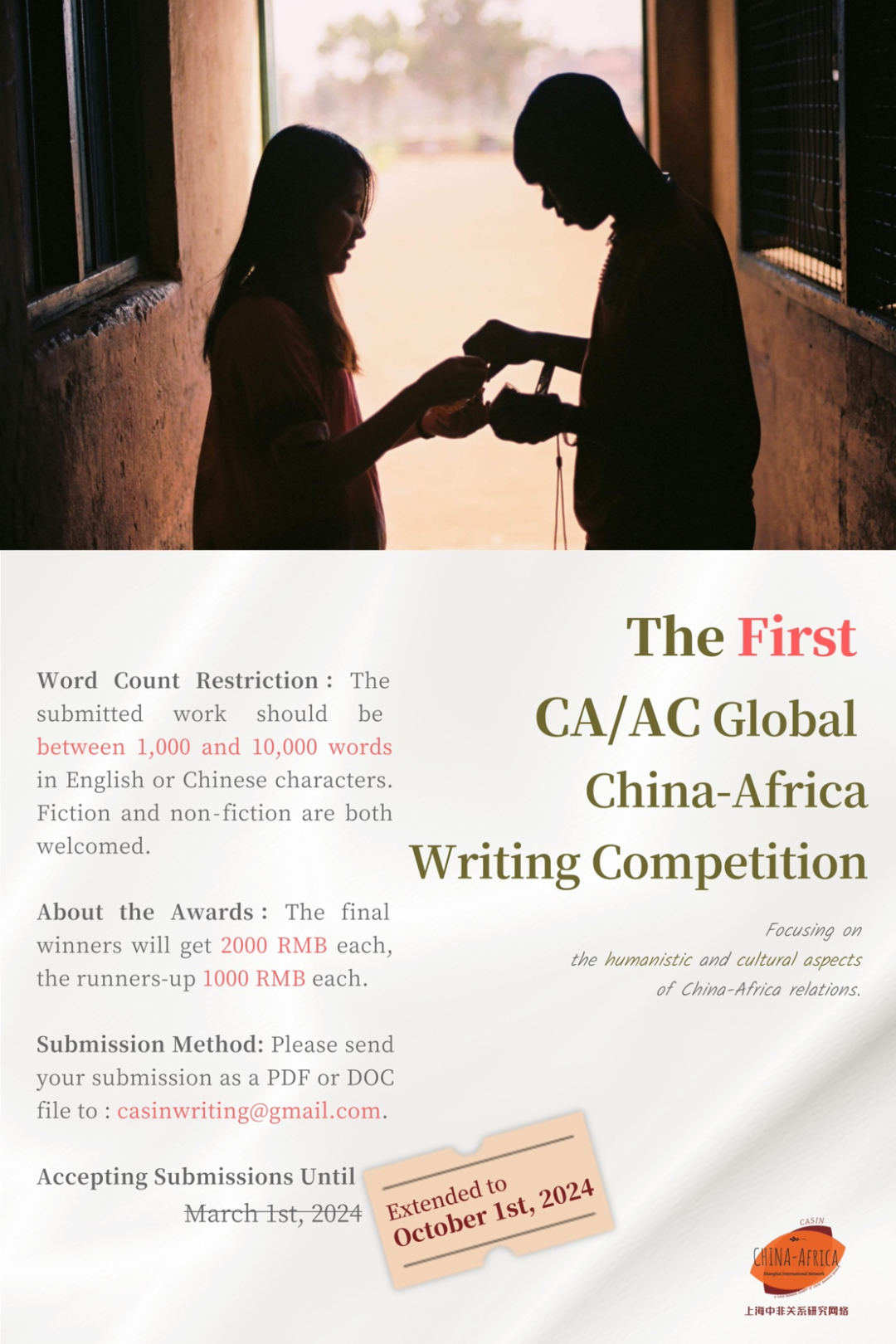
The First CA/AC Global China-Africa Writing Competition is accepting submissions till the 1st of October 2024!
We are extending the deadline of our first global China-Africa writing competition to the 1st of October 2024! Check out the following sections of this article for more detailed information about the competition rules and further details.
Along with this updated announcement of the extended submission period, we also wish to take this opportunity to further clarify and emphasize our vision for this competition, including the cultural context of its making, the kind of works we wish to see, and the important goals we wish to achieve with it.


Ever since the initiation of FOCAC (Forum of China Africa Cooperation) in 2000, the discursive field of China-Africa relations has been dominated by discussions on politics and economics, and academia is no exception. However, this means that the human aspects of China-Africa interactions have largely been sidelined by mainstream discourses and much work remains to be done for people to understand and appreciate the complex dynamics of race, culture, and social relations that shape how Chinese and African peoples see and interact with each other.
Within this context, this competition has been planned with the goal to contribute to a humanistic turn in understanding China-Africa relations. Such a humanistic turn means that through the power of cultural creativity we wish to fight against endemic misperceptions and common stereotypes about China-Africa interactions found in the mediascape dominated by Western perspectives and similar racial and cultural prejudices that Chinese and African peoples may harbor against each other. It aims to contribute to a more nuanced approach to examining the interpersonal aspects of China-Africa interactions. This is not to say that we only look for works that paint a rosy picture of China-Africa interactions. Rather, we believe that prejudices and conflicts can be dealt with in literature that nevertheless make the reader see the desires and weaknesses we share as complex human beings.
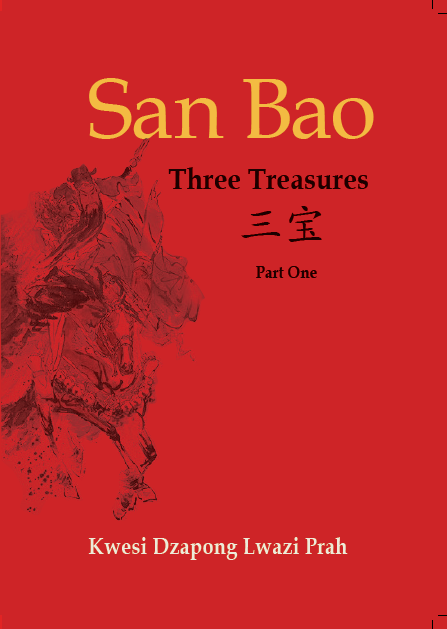
Sanbao: Three Treasures (2021)by Kwesi Dzapong Lwazi Prah published by African Century Editions Press in Cape Town, South Africa

Notably, a number of literary works have emerged in the last decade or so, which have greatly enhanced the cultural sphere of China-Africa relations from different perspectives and with artistic flair. Examples in fiction include Black Ghosts (2013) by Ken Kamoche, Congo Inc.: Bismarck’s Testament (2014, originally written in French) by Koli Jean Bofane, A Casualty of Power (2016) by Mukuka Chipanta, The Dragonfly Sea (2019) by Yvonne Adhiambo Owuor, Sanbao: Three Treasures (2021) by Kwesi Dzapong Lwazi Prah, who is serving as one of our competition judges this year, and The Surging Zaire River (涌动的伊扎尔河 2023) by Cai Xiao (蔡啸) and more. Examples in non-fiction are too many to count but the notable ones include the travel writings by Liangzi (梁子), the family memoirs by Ufrieda Ho and Darryl Accone, the culinary writings of Emma Chen and Ming-cheau Lin, and many more. For a recent scholarly assessment of China-Africa literature, please see Duncan Yoon’s China in Twentieth- and Twenty-First-Century African Literature (2023).
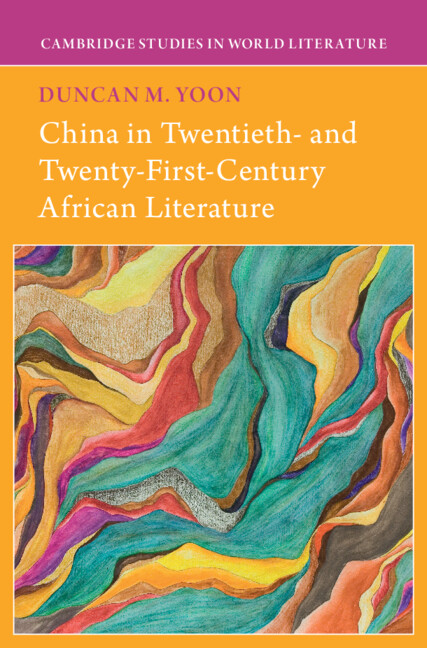
Duncan Yoon’s China in Twentieth- and Twenty-First-Century African Literature (2023 Published by Cambridge University Press)
The provocative reflections and creative energy brought by these works must be applauded and yet it is our observation that the landscape of China-Africa writings tend to be dominated by these long works published as books. Shorter forms of writing, especially short stories, tend to get sidelined by scholarly as well as public attention. This is partly due to the mixed quality of many short writings out there, as many reportages and commentaries on China-Africa relations tend to be reductive and lopsided. In the realm of short fiction, racial stereotypes pertaining to different sorts of Yellow Peril/Black Peril discourses abound in popular genres like sci-fi and web novellas.
However, we believe that short writings possess immense potential to fulfill our mission to deepen our understanding of the human aspects of China-Africa relations. Short writings, fiction and non-fiction alike, are accessible with better dissemination, and if done well, capable of shaking up readers’ world views and resonating with their souls. They offer more efficient reading experiences and induce immediate reactions and reflections. Being recognized with their short writings would also give the writers more confidence in writing something longer or doing more research on related topics.

With its promised monetary rewards and the wider critical recognition for the authors, we hope to use this competition to encourage short writings that are:
Aware of the common misperceptions about China-Africa relations and seeking to bring more nuances to current debates
Not reducing Chinese or African characters to mere tropes of common strereotypes
Not afraid to confront sensitive issues in China-Africa interactions
Uncovering different perspectives on Chinese lives in Africa and African lives in China
Offering new and humanistic angles for understanding the conflicts and friendships between Chinese and African peoples
Employing genres rarely seen in existing China-Africa literature such as romance, personal diaries, science fiction, thrillers, historical fiction, crime fiction, and other modernist styles that go beyond everyday realism
It is our hope that the selected finalists of this year’s competition will set good examples for the future of China-Africa writings and lay a solid foundation for our continued effort to building this platform of China-Africa creativity. Please share the information widely with your colleagues and friends.
Dr. Flair Donglai Shi, Shanghai Jiao Tong University
Competition Manager
2024 March 23 Addis Ababa
About the Competition
Aiming to enhance the humanistic aspect of China-Africa relations and promote mutual appreciation of Chinese and African cultures and civilizations,China-Africa Shanghai International Network (CASIN) will launch “The First AC/CA Global China-Africa Writing Competition” on 20 July 2023. We call for submissions of writings from around the world in two categories: fiction and non-fiction, and outstanding authors will be rewarded with monetary encouragements and honorary awards. It is our hope that the submitted writings focus on the humanistic communication between China and African countries. These works shall highlight the everyday and affective aspects of the intercultural interactions between Chinese and African peoples, present both the emerging opportunities and persistent challenges in these interactions, and thus demonstrate the diversity and great potential of creative approaches to understanding China-Africa relations today.
About the Organizer
China-Africa Shanghai International Network (CASIN) is a local network chapter (LNC) of the world's largest independent, interdisciplinary China-Africa research network, Chinese in Africa/Africans in China Research Network (CA/AC). The CA/AC Research Network was established in 2007, which currently hosts over 1,000 members around the world and includes experts in academia, diplomacy, media & communications, the arts & humanities, and international development. Our mission is to help move the global conversation about China-Africa forward in a critical and constructive way while developing a transnational community of scholars and practitioners who value dialogue, equity, and inclusiveness.
Competition Rules and Key Dates
Submission Method: Please send your submission as a PDF or DOC file to this email address:
casinwriting@gmail.com
Please make sure that no personal information is disclosed in the actual submission. You may introduce yourself in the email or attach a separate file of brief biography.
Accepting Submissions Until:
October 1st, 2024
Submission Requirement:
-
The submitted works should focus on the humanistic and cultural aspects of China-Africa relations;
-
Please indicate whether your submission is fiction or non-fiction in the file name of the PDF or DOC file;
-
If the original language of composition of the submission is neither Chinese nor English, please provide a Chinese or English translation;
-
The category of fiction here mainly refers to short stories/novelettes, while nonfiction may include travelogues, prose essays and short commentaries. Please be aware that poetry and standard academic essays are not accepted genres for this competition;
-
The submitted work must be original and remains unpublished for the duration of this competition.
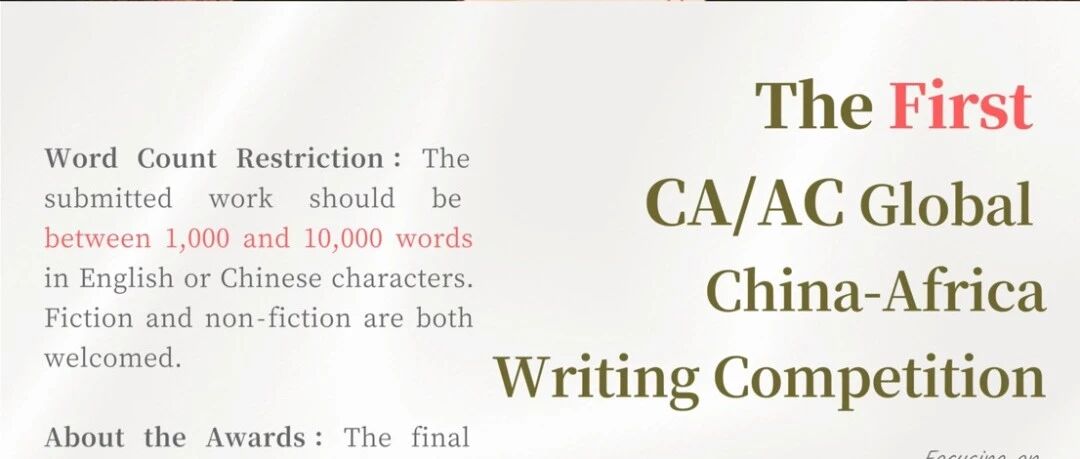
Word Count Restriction:The submitted work should be between 1,000 and 10,000 words in English or between 1,000 and 10,000 Chinese characters. Please state the word count of the piece in the final page of the document. Works that have word counts that do not fall within this range will not be considered.
About the Awards:Fiction and non-fiction will be evaluated separately, and each category will have a final winner and a runner-up. The final winners will get 2000 RMB each, the runners-up 1000 RMB each. All winning pieces and a select pool of excellent works will be published online via our social media handles, and there will be an awarding ceremony and dinner in Shanghai for the awardees. We will partially subsidize their travel and accommodation expenses subjective to our financial situation in 2024. There is a possibility that the winning pieces will be selected for edited book publication in the future.
Result Announcement:late October 2024
Award Ceremony:November 2024
Evaluation Method:The judges will read and mark each submission anonymously, and all the submissions will then be ranked according to their average mark to decide who the winners and runners-up are. If the top works happen to have the same mark, the judges will discuss and vote to decide which work shall receive the award(s).
List of Judges for 2023-2024
*Flair Donglai SHI (Shanghai Jiao Tong University) (*competition manager, with no right to vote)
Cheng Ying (Peking University)
Kwesi Dzapong Lwazi Prah (University of South Africa)
Ignatius Suglo (University of Pennsylvania)
Mingqing Yuan (Friedrich-Alexander-Universität Erlangen-Nürnberg)
Zhang Yong (Zhejiang University)
本文首发于 CASIN 微信公众平台。
查看原文 ↗